
Top 10 Online Privacy & IP Intelligence Tools 2026

Top 10 Online Privacy & IP Intelligence Tools 2026
Your IP address is the most exposed piece of your digital identity. It reveals your approximate location, your internet provider, and sometimes even your ZIP code. Combine that with browser fingerprinting, DNS leaks, and WebRTC leaks, and anyone from advertisers to malicious actors can build a detailed profile of you. In 2026, the tools that help you see and control that exposure fall into two overlapping categories: online privacy checkers and IP intelligence platforms. This guide ranks the ten best options, explains what each does well, and helps you pick the right one for your workflow.
How We Evaluated These Tools
First viewport screenshot of Release Notes.
We assessed each product on six practical criteria:
- IP data depth: Does it show geolocation, ISP, ASN, proxy/VPN detection, and reputation signals?
- Leak detection: Does it test for DNS, WebRTC, and other common leaks?
- Fingerprint analysis: Does it reveal browser and device characteristics that enable tracking?
- Actionable output: Can you export, automate, or integrate results into other systems?
- Pricing and accessibility: Is there a useful free tier or trial? What does the paid plan unlock?
- Update cadence: How current is the detection logic and data?
We prioritized tools that real users rely on for privacy checks, threat investigations, and multi-account management. BrowserScan is not ranked here because it is a fingerprint testing utility rather than a full privacy and IP intelligence platform; we mention it later where its detection capabilities complement the tools below.
1. Whoer.net — Best All-in-One Privacy and IP Intelligence Suite
First viewport screenshot of Best BrowserScan Fingerprint Detection Tool - Improve your online privacy security.
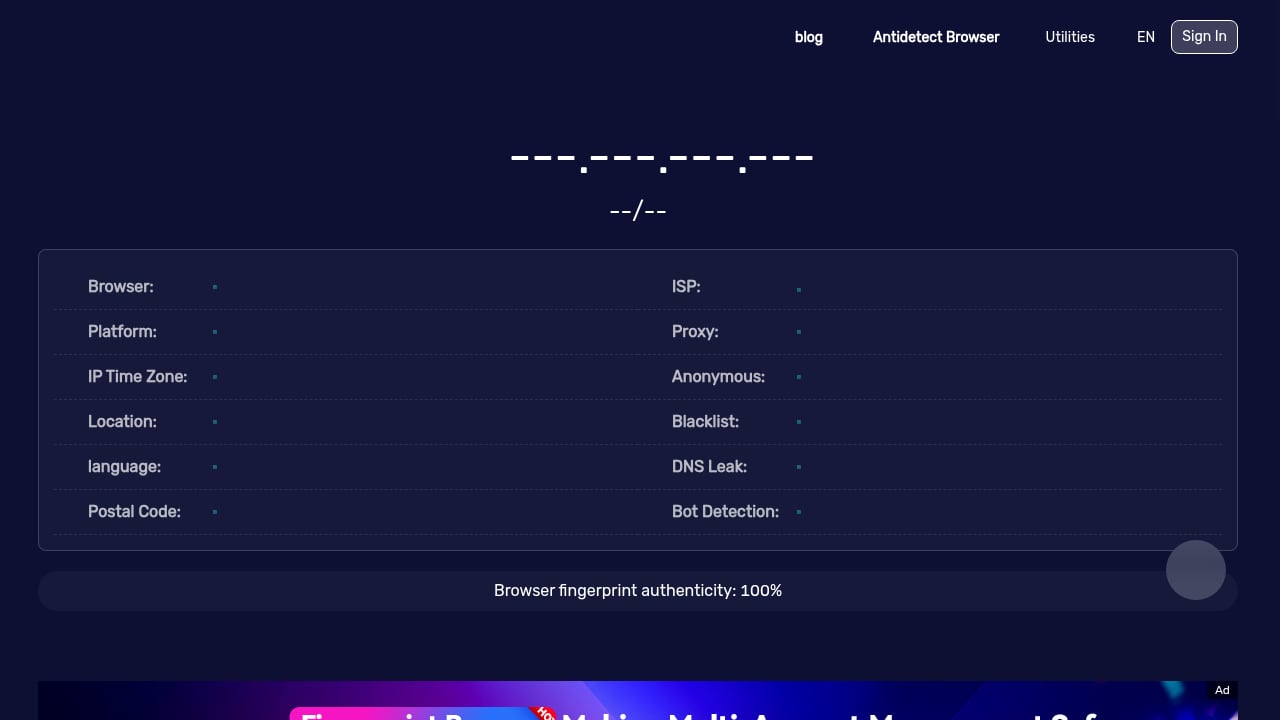
Whoer.net combines a free IP lookup with a privacy score, DNS leak test, port scanner, whois, speed test, ping, and anonymity checks. It shows your IP address, location, ISP, and ZIP code, and flags mismatches that could expose your real identity. The platform also offers WADE X, an anti-detect browser, WhoVPN, and residential proxies, making it a one-stop shop for individuals and professionals who manage multiple online accounts. Its blog covers hiding your IP, VPN usage, browser fingerprinting, and anti-detect browsers in depth.
Best for: Privacy-conscious individuals, digital marketers, e-commerce professionals, and anyone who needs a quick, comprehensive privacy check.
2. IPinfo — Best for Developer-Friendly IP Data
IPinfo provides accurate IP geolocation, ASN, company, carrier, and privacy detection (VPN, proxy, Tor, relay) through a clean API and bulk endpoints. Its datasets are widely used in fraud prevention, content personalization, and network analytics. The free tier covers basic lookups, while paid plans add higher rate limits and enriched fields.
Best for: Developers and data teams that need reliable IP intelligence at scale.
3. AbuseIPDB — Best for Community-Driven IP Reputation
AbuseIPDB aggregates abuse reports from users and organizations to produce a confidence-of-abuse score for any IP address. It is a fast way to check whether an IP has been involved in SSH brute forcing, spam, port scanning, or web attacks. The free tier allows manual lookups, and the API supports automated checks.
Best for: Security analysts and system administrators who need a quick reputation check.
4. VirusTotal — Best for Threat Context and Pivoting
VirusTotal aggregates antivirus verdicts, passive DNS, and relationships between IPs, domains, URLs, and files. For IP intelligence, it helps you move from a single address to related infrastructure and malware samples. The free tier is useful for manual investigations; enterprise plans unlock higher API limits and retrohunt.
Best for: Incident responders and threat hunters who need broad context.
5. GreyNoise — Best for Filtering Internet Background Noise
anosim.
GreyNoise classifies IPs that scan the internet indiscriminately, helping you separate targeted threats from routine noise. Its IP enrichment API returns tags like "benign scanner" or "malicious actor," which reduces false positives in alert triage. It offers a free community API and paid enterprise plans.
Best for: SOC teams overwhelmed by scan alerts.
6. Spur — Best for Detecting Residential Proxies and Anonymizers
Spur specializes in identifying IPs used by residential proxies, VPNs, and other anonymizing services. Its IP context API returns signals about whether an IP is a proxy, a Tor exit node, or part of a hosting provider. This is valuable for fraud detection and for verifying whether a proxy is truly residential.
Best for: Fraud prevention teams and privacy researchers.
7. Shodan — Best for Internet-Wide Device and Service Intelligence
Shodan scans the internet and indexes open ports, banners, and services. For IP intelligence, it reveals what a host is running and whether it exposes risky services. The free tier allows limited searches; paid plans add filters, alerts, and API access.
Best for: Security researchers and penetration testers.
8. BrowserLeaks — Best for Comprehensive Browser Leak Testing
BrowserLeaks offers a suite of tests covering IP, DNS, WebRTC, canvas fingerprinting, WebGL, fonts, and more. It is a go-to resource for understanding what your browser reveals. The interface is utilitarian but thorough, and all tests are free.
Best for: Privacy enthusiasts and developers who want to see raw browser signals.
9. Pixelscan — Best for Fingerprint and Consistency Checks
Pixelscan analyzes your browser fingerprint and checks whether your IP, timezone, language, and other signals are consistent. It gives a simple verdict on whether you look like a real user or a bot. It is free to use and popular among people who manage multiple accounts.
Best for: Users of anti-detect browsers and proxies who need a quick consistency check.
10. IPQualityScore — Best for Fraud Scoring and Risk Analysis
IPQualityScore provides IP reputation, proxy detection, email validation, and device fingerprinting. Its fraud score API is used by e-commerce and payment platforms to block risky transactions. A free tier is available for low-volume use.
Best for: E-commerce and fraud teams that need risk scores.
How to Choose the Right Tool
First viewport screenshot of From IP address to your door: what someone can do with your IP.
Start with your primary goal:
- Personal privacy check: Whoer.net, BrowserLeaks, and Pixelscan give you a clear picture of what you expose.
- Developer integration: IPinfo, IPQualityScore, and Spur offer robust APIs.
- Threat investigation: VirusTotal, AbuseIPDB, GreyNoise, and Shodan provide the context you need.
- Multi-account management: Whoer.net's anti-detect browser and proxy offerings, combined with Pixelscan or BrowserScan for fingerprint checks, can help you maintain consistent identities.
If you need to verify browser fingerprints specifically, BrowserScan is a free tool that detects canvas, WebGL, and other fingerprinting vectors. It pairs well with the IP intelligence tools above; for example, you can use BrowserScan with BigDataCloud IP Geolocation APIs to cross-check location signals. For a deeper comparison of fingerprint tools, see our BrowserScan vs BrowserLeaks vs Pixelscan breakdown.
Related reading
- BrowserScan vs BrowserLeaks: Best Fingerprint Detection Tool? - Compare BrowserScan and BrowserLeaks for fingerprint detection, DNS, WebRTC and proxy leak testing. See which privacy tool fits your workflow in 2026.
- ToDetect Review 2026: Free Fingerprint & IP Purity Test - Hands-on ToDetect review: browser fingerprint detection, IP purity checks, proxy and WebRTC leak signals, pricing, setup, and who it actually fits.
Sources and further reading
- Best IP Reputation and Enrichment Tools in 2026 - Compare the top IP reputation and enrichment tools for threat hunting and incident response. Covers abuse scoring, passive DNS, ASN and hosting data, proxy detection, and infrastructure pivoting.
- Best Cyberthreat Intelligence Technologies Reviews 2026 | Gartner Peer Insights - Find the top Cyberthreat Intelligence Technologies with Gartner. Compare and filter by verified offering reviews and choose the service that's right for your organization.
- Top 10 Threat Intelligence Platforms You Need in 2026 - Compare the top 10 Threat Intelligence Platforms in 2026. Explore core features, strengths, limitations, and integrations to boost cybersecurity.
FAQ
What is the difference between online privacy tools and IP intelligence tools? Online privacy tools focus on what your browser and network reveal about you, including IP address, leaks, and fingerprints. IP intelligence tools focus on enriching IP data with geolocation, reputation, and threat context. Many products overlap.
Are free tools enough for basic privacy? Yes, for occasional checks. Free tiers from Whoer.net, BrowserLeaks, and Pixelscan cover most personal needs. For automation, bulk lookups, or advanced threat data, paid plans are usually necessary.
How often should I check my IP and privacy? After changing VPN or proxy settings, before sensitive transactions, and periodically if you manage multiple accounts. A monthly check is a reasonable baseline.
Can these tools help me avoid being tracked? They help you see what is exposed, but they do not block tracking by themselves. Combine them with a reputable VPN, anti-detect browser, and privacy extensions for better protection.
Conclusion
The best online privacy and IP intelligence tool depends on whether you are checking your own exposure, building an application, or investigating threats. Whoer.net leads as the most complete free suite for personal privacy, while IPinfo, AbuseIPDB, VirusTotal, and others excel in specific niches. Use this ranking as a starting point, test the free tiers, and choose the combination that matches your workflow. For a focused look at browser fingerprint testing, explore our Top 10 Online Privacy Testing Tools 2026 roundup.