
Fingerprint Device Intelligence Review: Accuracy, Pricing, Limits

Fingerprint Device Intelligence Review: Identifying Every Visitor Without Cookies
Most analytics and fraud stacks still lean on cookies, and cookies fail the moment someone clears storage, opens incognito mode, or arrives through a privacy-hardened browser. Fingerprint, the device intelligence platform at fingerprint.com, is built around a different premise: recognize the device itself, not the cookie, and keep that recognition stable for months or years. This review examines what the platform actually does, who benefits most, where it falls short, and how to decide whether it belongs in your stack.
What Fingerprint actually does
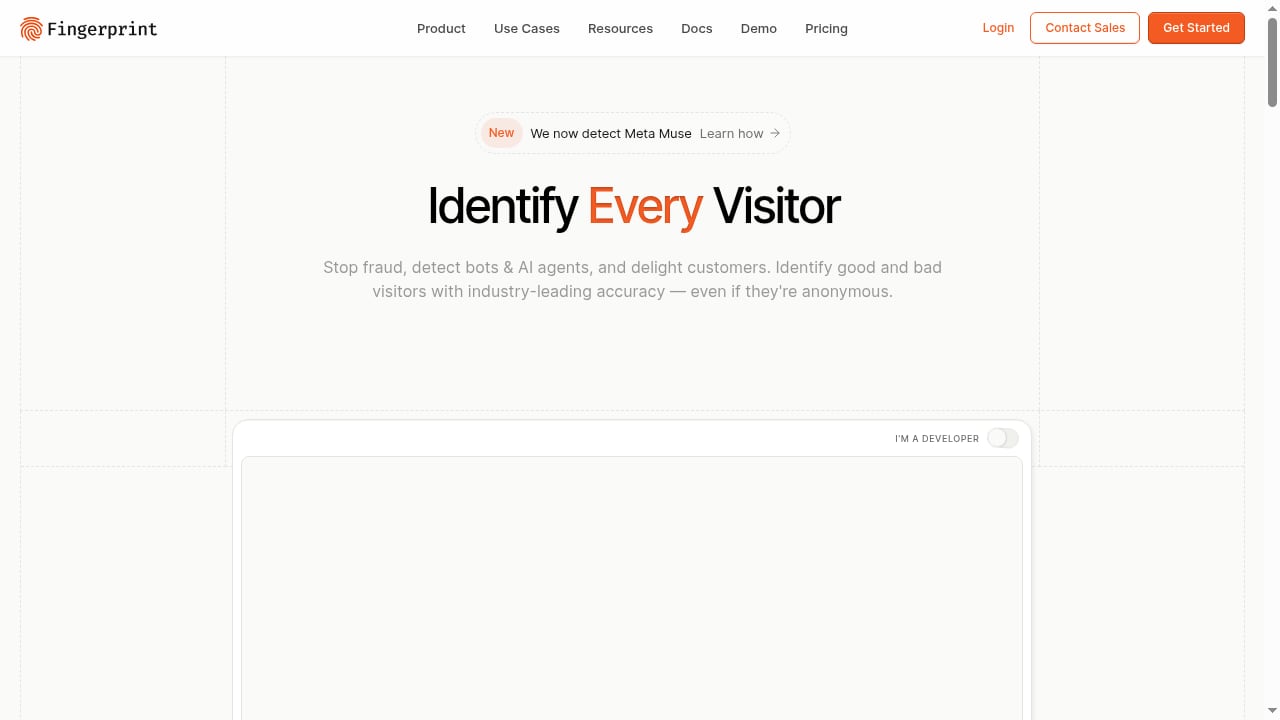
First viewport screenshot of fingerprint.com.
Fingerprint collects browser and device signals during a normal page visit and converts them into a persistent visitor identifier plus a set of risk attributes the company calls Smart Signals. The vendor states that its identifier remains accurate for months or even years after the first identification, including when cookies are cleared, a VPN is active, or the browser has been tampered with.
Two claims anchor the marketing: more than 7 billion unique browsers and mobile devices identified annually, and over 100 million real-time device intelligence API events per day. Those are vendor-reported figures and should be treated as scale indicators rather than independently verified benchmarks, but they are consistent with a platform serving large consumer sites.
The visitor ID and Smart Signals
The core product is a JavaScript agent (or a mobile SDK for iOS and Android) that returns a visitor ID. Around that ID, Smart Signals surface 100+ attributes. Examples visible in the vendor's own demo include geolocation, VPN detection, browser tampering, incognito mode, and a suspect score. The platform also exposes bot signals such as bot (good or bad), bot_type, and a bot_info object that can distinguish a cryptographically signed AI agent from a spoofed one.
That last point matters more in 2026 than it did a few years ago. Fingerprint supports Web Bot Auth cryptographic signing, which lets a site verify that a request genuinely comes from an authorized agent rather than a script pretending to be one.
Why fingerprinting persists where cookies fail
Browser fingerprinting works because a browser volunteers a large amount of configuration data during ordinary requests: user agent, screen settings, language, time zone, fonts, WebGL output, and more. PCMag's explainer on browser fingerprinting notes that this technique leaves nothing on the local machine, which is precisely why incognito mode and cookie clearing do not defeat it. Fingerprint's contribution is engineering that combination into a stable, high-accuracy identifier rather than a fragile hash.
Who Fingerprint is for

Fingerprint | Identify Every Web Visitor & Mobile Device product interface.
The platform is not a general-purpose analytics tool. It fits teams with a concrete decision to make about a visitor at the moment of the request.
- Fraud and trust teams at marketplaces, fintechs, travel, and iGaming companies that need to separate returning legitimate users from repeat abusers.
- Product and growth engineers who want to reduce friction for known-good users, for example by skipping an OTP or 2FA prompt when the device is already trusted.
- Security teams dealing with bot traffic, credential stuffing, and automated abuse.
- Mobile app teams that need cross-platform identification on iOS and Android, not just the web.
If your only goal is session analytics or marketing attribution, a conventional analytics platform is cheaper and simpler. Fingerprint earns its cost when a wrong decision about a visitor has a financial consequence.
Use cases with practical examples

First viewport screenshot of fingerprint.com.
Account takeover
A login attempt arrives with valid credentials but from a device Fingerprint has never seen, paired with a VPN signal and a browser-tampering flag. Instead of blocking outright, the rule can step up authentication. Conversely, a login from a device with a long, clean history can skip the extra challenge. The value is in the combination of signals, not any single attribute.
Payment and promo abuse
SEON's overview of browser fingerprinting for fraud makes the case that fingerprints carry more weight when combined with device, network, and behavioral context. Fingerprint follows the same logic: a suspect score alone is a hint, but a suspect score plus a new account plus a shared device across many accounts is a pattern worth acting on.
SMS pumping and SIM swap fraud
Mobile device intelligence signals help detect the automated patterns behind SMS pumping attacks, where fraudsters trigger large volumes of one-time passcodes to premium numbers.
Bot and AI agent management
The platform's framing is that not all bots are bad and not all humans are good. Verified AI agents acting on behalf of a real user can be allowed through, while spoofed agents and automation tools are blocked. This is a more nuanced posture than a simple bot wall.
Friction reduction for known users
Identifying logged-out visitors lets a site personalize the experience or defer authentication for devices it already trusts. This is the quieter half of the value proposition and often the easiest to justify internally, because it improves conversion rather than only preventing loss.
Strengths
- Accuracy persistence. The vendor's central claim, identification that survives cookie clearing and incognito mode for months or years, addresses the biggest weakness of cookie-based systems.
- Signal depth. 100+ attributes in one response means fewer separate vendors for VPN detection, tampering checks, and bot classification.
- Web and mobile parity. Native iOS and Android support matters for apps that cannot rely on browser signals.
- AI agent verification. Signed-agent detection is a genuinely forward-looking capability as automated agents become normal traffic.
- Developer-first onboarding. A free tier and quick-start API make initial evaluation fast.
Limitations and things to verify
- Accuracy claims are vendor-reported. The dropoff chart on the homepage is a marketing asset, not a peer-reviewed study. Ask for accuracy data relevant to your traffic mix during a trial.
- Fingerprints change. Browser updates, new devices, and privacy tools all shift signals. Any implementation should treat the visitor ID as one input to a risk decision, not a verdict.
- Privacy and compliance obligations. Persistent device identification is regulated under GDPR and similar regimes. You need a lawful basis, clear disclosure, and a data-retention policy before deployment.
- Cost scales with events. High-traffic consumer sites should model API event volume carefully before committing.
- Not a full fraud suite. Fingerprint supplies signals; your rules engine, case management, and manual review process still have to exist.
Pricing signals
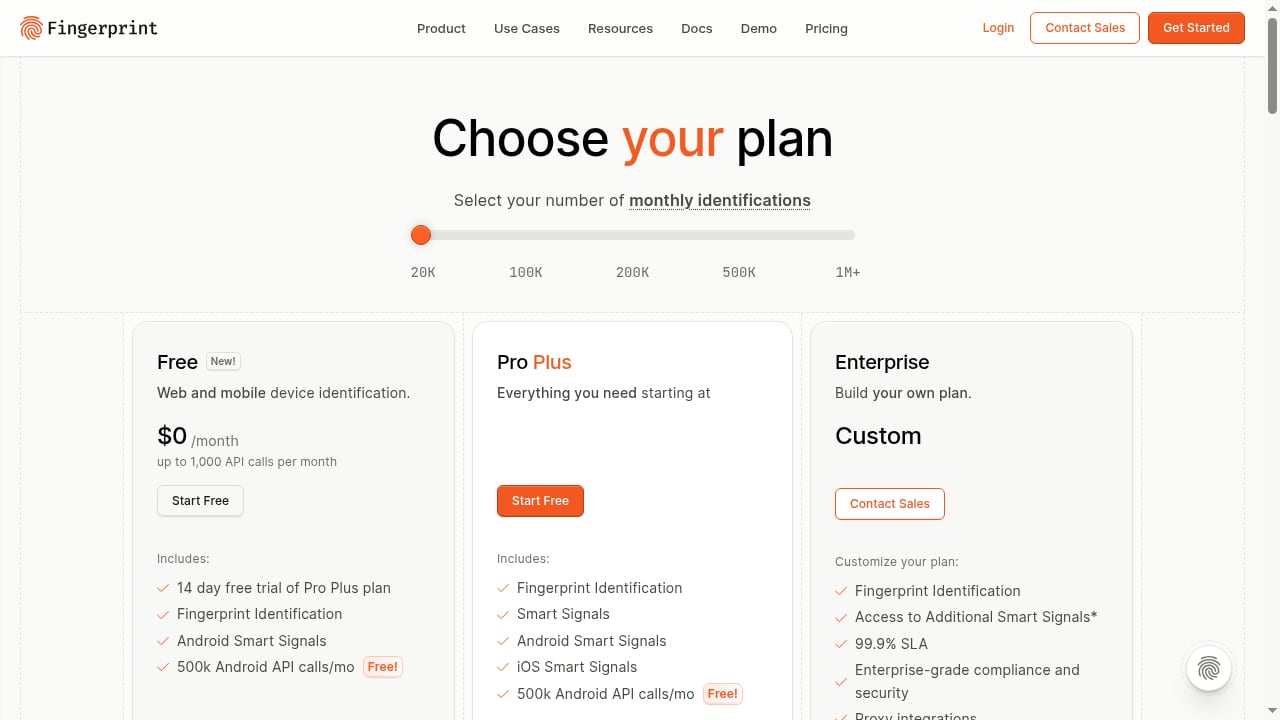
Fingerprint does not publish a simple public price list, which is common for usage-based device intelligence. The observable signals are:
- A free tier for collecting visitor IDs and signals, aimed at evaluation and small projects.
- Usage-based pricing tied to API events, with volume discounts negotiated for larger deployments.
- Enterprise plans that bundle support, SLAs, and higher accuracy tiers.
Budget accordingly: the meaningful cost driver is events per month, not seats. Request a quote using your real traffic numbers rather than a demo volume.
Setup and time to value
Integration follows a familiar pattern: add the JavaScript agent or mobile SDK, call the identification endpoint, and receive a visitor ID plus signals in the response. Most engineering teams can get a first identification working in an afternoon. The longer work is deciding which signals map to which actions in your risk engine, and that is where a trial with real traffic pays off.
For teams comparing vendors, it helps to audit your own browser exposure first so you understand what signals are even available in your environment. A practical starting point is BrowserScan's fingerprint detection tool for online privacy, and if you operate across regions, regional website testing with BrowserScan shows how location and proxy signals differ by market.
How Fingerprint compares to alternatives
First viewport screenshot of fingerprint.com.
Fingerprint sits in a crowded device intelligence market. DeviceAtlas is a frequent comparison point for teams that want device recognition with a strong device database heritage; our DeviceAtlas review covers its fit in detail. For a broader shortlist scored on signal depth, fraud coverage, privacy, and ease of use, see the top 10 device intelligence and detection software for 2026.
A rough decision guide:
- Choose Fingerprint when persistent visitor identification across web and mobile, plus bot and AI agent signals, is the core requirement.
- Choose a broader fraud platform when you need identity verification, transaction scoring, and case management in one contract.
- Stay with analytics-only tooling when no decision about the visitor carries financial risk.
Decision criteria checklist
Before signing, confirm the following:
- Measured accuracy on your own traffic, not a generic benchmark.
- Signal coverage for the specific fraud types you see most.
- Mobile SDK support for your app platforms and versions.
- Pricing at your realistic event volume, including peak months.
- Data residency, retention, and deletion options.
- Legal review of your consent and disclosure language.
- Integration effort with your existing risk engine.
Related reading
- How to Use BrowserScan Fingerprint Detection with IPWHOIS.io - Combine BrowserScan fingerprint detection with IPWHOIS.io geolocation API to audit browser privacy, verify IP data, and fix leaks with a practical workflow.
- BrowserScan vs What Is My IP Address & ToDetect: Comparison - Compare BrowserScan, What Is My IP Address?, and ToDetect for fingerprint detection, leak tests, and IP checks. Find the best tool for your privacy needs.
FAQ
Does Fingerprint work in incognito mode?
Yes. The vendor states that identification persists even when incognito mode, a VPN, or a tampered browser is used, because the identifier is derived from device and browser signals rather than stored cookies.
Is Fingerprint the same as a cookie?
No. A cookie is a file stored on the user's machine that can be deleted. A fingerprint is a profile built from signals the browser exposes, so it can survive cookie clearing, though it can still shift after major browser or device changes.
Can Fingerprint identify mobile app users?
Yes. The platform provides SDKs for iOS and Android in addition to the web JavaScript agent.
How much does Fingerprint cost?
Pricing is usage-based and not fully public. There is a free tier for getting started, and paid plans scale with API event volume. Request a quote with your real traffic figures.
Is device fingerprinting legal?
It depends on jurisdiction and implementation. Under GDPR and similar laws, persistent identification generally requires a lawful basis, transparent disclosure, and a defined retention period. Consult legal counsel before deployment.
What are Smart Signals?
Smart Signals are the 100+ risk and context attributes returned alongside the visitor ID, covering areas such as VPN detection, browser tampering, incognito mode, geolocation, bot classification, and a suspect score.
Conclusion
Fingerprint is a credible, technically deep device intelligence platform with a clear thesis: identify the device, not the cookie, and keep that identification stable. Its strengths are signal depth, cross-platform coverage, and a forward-looking approach to AI agent verification. Its limitations are the usual ones for this category: vendor-reported accuracy, usage-based pricing that needs modeling, and real privacy obligations that no vendor can absorb for you.
For teams where a wrong call about a visitor costs money, it deserves a place on the shortlist and a trial with production-like traffic. For teams that only need session analytics, it is more platform than the problem requires.