
Top 10 Device Intelligence & Detection Software 2026

Top 10 Device Intelligence and Detection Software Products for 2026
Device intelligence has moved from a niche anti-fraud add-on to a core layer in identity, risk, and personalization stacks. The reason is structural: most identity checks happen once, at sign-up. After that, accounts are treated as trusted, and attackers exploit the gap with account takeover, multi-accounting, emulator farms, and synthetic identities. Device intelligence closes that gap by continuously reading technical, behavioral, and network signals from the device itself.
This 2026 review ranks ten products that genuinely belong to the device intelligence and detection category. It is written for buyers who need a shortlist they can defend, not a vendor brochure. Browser fingerprint testing tools such as Best BrowserScan Fingerprint Detection Tool - Improve your online privacy security sit in an adjacent privacy-testing workflow; they are useful for auditing what your own browser exposes, but they are not device intelligence platforms and are not ranked here.
How We Evaluated These Products
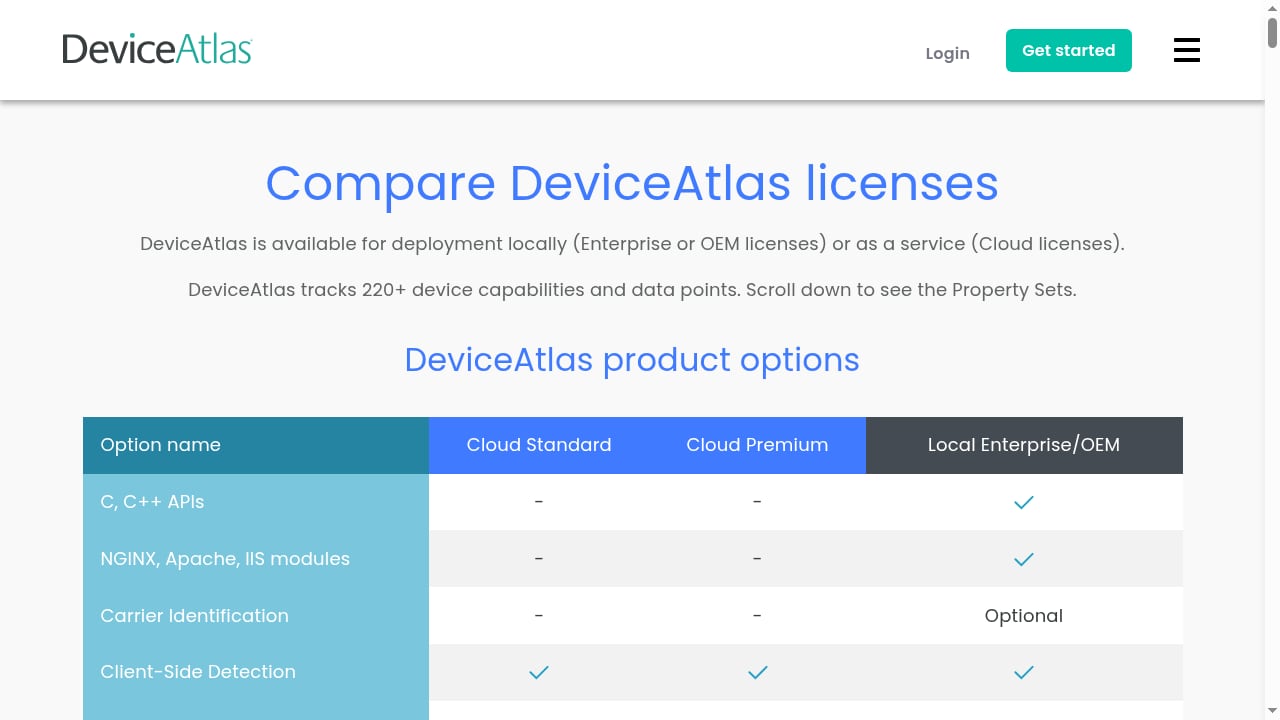
First viewport screenshot of Compare DeviceAtlas Licenses.
Every product below was scored against the same six criteria, weighted for 2026 buying realities:
- Signal depth (25%) — how many device, network, and behavioral attributes are analyzed, and whether the platform detects emulators, virtual machines, automation, and anti-detect tooling.
- Detection and decisioning (20%) — whether the product returns raw signals, a persistent device ID, pre-scored risk, or all three, and how usable that output is in fraud or personalization models.
- Coverage and stability (15%) — cross-browser and cross-session persistence, mobile and web parity, and geographic reach.
- Privacy and compliance architecture (15%) — whether the platform is PII-free by design, how it handles consent, and how it fits GDPR, LGPD, and DPDP obligations.
- Integration and time-to-value (15%) — SDK versus server-side deployment, documented APIs, and how quickly a lean team can go live.
- Transparency (10%) — published pricing signals, documentation quality, and verifiable customer evidence.
Scores are relative, not absolute. A platform that wins on signal depth may lose on transparency, and the right choice depends on whether you are stopping fraud, personalizing content, or both.
The Top 10 Device Intelligence and Detection Products for 2026
First viewport screenshot of DeviceAtlas - Device Intelligence.
1. DeviceAtlas — Best Overall for Device Awareness Across Touchpoints
DeviceAtlas is a device intelligence platform that identifies and verifies connected devices in real time and returns actionable device data at every customer touchpoint. It is strongest where device awareness has to serve several teams at once: AdTech targeting, eCommerce optimization, streaming and gaming experience tuning, analytics enrichment, and fraud prevention.
Its detection stack covers device identification from HTTP headers, device authentication to flag anomalies, user-agent spoofing detection, and bot identification. It tracks more than 220 device capabilities and data points, which is what makes it useful beyond security — the same data can drive content tailoring, segmentation, and ad decisioning. Deployment is flexible: cloud licenses (Starter, Professional, Enterprise) or local deployment for Enterprise and OEM customers. Published customer names include Adjust, Adobe, Adoppler, DynAdmic, Equativ, Everflow, and Fospha.
Strengths: broad device coverage, spoofing and bot detection, dual cloud/on-prem options, strong AdTech and analytics fit. Limits: less focused on deep behavioral risk scoring than fraud-first platforms; best value at enterprise scale. Best for: AdTech, media, eCommerce, streaming, and analytics teams that need one device data layer for many use cases. For a deeper breakdown, see our DeviceAtlas review.
2. Fingerprint — Best Developer-First Persistent Device ID
Fingerprint assigns a persistent visitor ID from a large signal set and layers Smart Signals on top: bot detection, VPN and proxy detection, incognito detection, emulator and VM detection, and geolocation spoofing detection. Its architecture is modular by design, which suits teams with in-house data science that want raw identification data and will build their own risk logic.
Strengths: high fingerprint persistence, clean API, broad standard browser and mobile coverage. Limits: not a complete fraud stack on its own; teams needing end-to-end case management must add tools. Best for: fintechs, SaaS platforms, iGaming, and eCommerce companies with developer resources.
3. SHIELD — Best Mobile-First Behavioral Device Intelligence
SHIELD combines device identification with behavioral analytics for Android and iOS applications, with a client base concentrated in Asia-Pacific and growing global coverage. Its mobile-native modeling is built around app-level abuse patterns rather than desktop browser signals.
Strengths: strong mobile fraud detection, behavioral modeling, regional depth in APAC. Limits: less relevant for desktop-only web businesses; pricing is quote-based. Best for: mobile apps in marketplaces, ride-hailing, eCommerce, and fintech facing multi-accounting and promo abuse.
4. JuicyScore — Best for Emerging-Market Risk and Credit Signals
JuicyScore is a device intelligence and risk scoring service built on aggregated risk indices derived from tens of thousands of device-level parameters. It produces predictive signals used in both fraud prevention and credit scoring, and its PII-free-by-design architecture simplifies compliance under GDPR, LGPD, and India's DPDP Act. Notable coverage includes DOM injection detection and remote-access tool detection.
Strengths: very deep signal set, stable cross-browser device ID, credit-risk use cases, emerging-market focus. Limits: less brand recognition in North America; best fit requires model integration work. Best for: banks, digital lenders, insurers, and marketplaces operating in high-diversity device markets.
5. Cyble Vision — Best for External Threat and Device Exposure Context
Cyble Vision is an AI-native platform that monitors surface, deep, and dark web sources and turns raw threat data into actionable intelligence. In a device intelligence context it is most useful for enriching device and account risk with external exposure signals such as leaked credentials and brand impersonation.
Strengths: large verified review base, AI-driven analysis, broad external risk coverage. Limits: not a device fingerprinting engine; value depends on integration with your identity stack. Best for: security teams that want device risk contextualized against external threats.
6. SOCRadar Extended Threat Intelligence — Best Free Start for Lean Teams
SOCRadar combines automation, AI agents, and analyst validation to deliver threat intelligence, digital asset discovery, and leak detection. It is one of the easiest platforms in the adjacent threat-intelligence space to trial without a sales call, which matters for small security teams.
Strengths: accessible entry point, natural-language risk summaries, agent marketplace. Limits: device-level identification is not its core; pair it with a dedicated device platform. Best for: teams of 20–1,000 users that need external risk context alongside device signals.
7. Recorded Future Intelligence Cloud — Best for Microsoft-Centric Security Stacks
Recorded Future collects and analyzes open web, dark web, and technical feeds, with real-time detection, risk scoring, and documented integrations. It has the most documented Microsoft integrations among the platforms reviewed in 2026 threat-intelligence comparisons.
Strengths: strong integrations, mature reporting, risk scoring. Limits: research-heavy workflow; requires analysts to act on findings. Best for: Microsoft Sentinel and Defender shops that want device and identity risk enriched with external intelligence.
8. CrowdStrike Falcon Adversary Intelligence — Best When You Already Run Falcon
CrowdStrike's intelligence ships inside the Falcon console, combining attacker profiles, dark web monitoring, and a malware sandbox with endpoint detection. Public pricing for the intelligence tier makes it one of the few options a buyer can budget without a call.
Strengths: published pricing, strong review base among mid-sized companies, YARA and Snort detection rules. Limits: analyst-facing options sit in higher tiers; less compelling for Microsoft-only environments. Best for: organizations already standardized on CrowdStrike that want device and endpoint risk in one place.
9. ZeroFox Platform — Best for Managed Takedowns
ZeroFox focuses on external risk monitoring with takedown services for impersonating domains, phishing sites, and exposed assets. It complements device intelligence by removing the external infrastructure attackers use to target trusted devices and accounts.
Strengths: hands-on takedowns, brand protection, external visibility. Limits: not a device identification product; overlap with device risk is indirect. Best for: brands facing impersonation and phishing that need remediation handled for them.
10. ReliaQuest GreyMatter — Best for Agentic Security Operations
GreyMatter orchestrates agentic AI personas and hundreds of agent skills to detect and contain threats faster, reducing Tier 1 and Tier 2 workload. It is a detection and response layer that consumes device and identity signals rather than generating them.
Strengths: fast containment, automation at scale, reduced analyst toil. Limits: requires existing telemetry sources; not a standalone device intelligence engine. Best for: security operations centers that want device signals turned into automated response.
Comparison: Which Product Fits Which Job
First viewport screenshot of Pricing.
| Job to be done | First choice | Strong alternative |
|---|---|---|
| Cross-team device data for AdTech, analytics, and UX | DeviceAtlas | Fingerprint |
| Mobile app fraud and multi-accounting | SHIELD | JuicyScore |
| Credit and fraud scoring in emerging markets | JuicyScore | SHIELD |
| Developer-built risk logic on a persistent ID | Fingerprint | DeviceAtlas |
| External threat context around device risk | Cyble Vision | Recorded Future |
| Lean team needing a free start | SOCRadar | ZeroFox |
| Existing CrowdStrike or Microsoft estate | CrowdStrike Falcon | Recorded Future |
A practical pattern is to pair one identification layer with one intelligence layer. For example, DeviceAtlas can supply device and spoofing signals while a threat-intelligence platform adds external exposure context. If your team also needs to verify what a browser exposes during testing, a privacy audit tool such as BrowserScan fingerprint detection is a sensible complementary check — but it should not replace a device intelligence platform in a fraud stack.
Practical Examples
First viewport screenshot of Case Studies.
eCommerce promo abuse. A retailer sees repeated sign-ups from the same physical device. A device intelligence platform links sessions across browsers, flags emulator use, and blocks the accounts before checkout. DeviceAtlas-style header analysis plus spoofing detection catches the user-agent manipulation often used to evade simple checks.
Digital lending in a high-diversity device market. A lender needs risk signals that work on low-end Android devices and unstable networks. A PII-free platform with deep device parameters and credit-risk indices can feed underwriting models without adding compliance burden.
AdTech targeting. A media buyer needs accurate device capability data to serve the right creative. Device capability tracking across 220+ data points prevents wasted impressions on unsupported devices and improves measurement.
Related reading
- How to Use BrowserScan Fingerprint Detection with IPWHOIS.io - Combine BrowserScan fingerprint detection with IPWHOIS.io geolocation API to audit browser privacy, verify IP data, and fix leaks with a practical workflow.
- BrowserScan vs What Is My IP Address & ToDetect: Comparison - Compare BrowserScan, What Is My IP Address?, and ToDetect for fingerprint detection, leak tests, and IP checks. Find the best tool for your privacy needs.
- BrowserScan vs WebBrowserTools: Fingerprint Detection Compared - Compare BrowserScan and WebBrowserTools for fingerprint detection. See which tool better protects your online privacy with leak tests and practical fixes.
Sources and further reading
- Best Device Intelligence Solutions and Platforms in 2026 - A practical comparison of 12 leading device intelligence solutions and platforms in 2026 – signal depth, privacy architecture, and vertical fit.
- Best Cyberthreat Intelligence Technologies Reviews 2026 | Gartner Peer Insights - Find the top Cyberthreat Intelligence Technologies with Gartner. Compare and filter by verified offering reviews and choose the service that's right for your organization.
- 10 Best Threat Intelligence Platforms for 2026 - 10 threat intelligence platforms ranked on live Gartner Peer Insights data, pricing, and fit for lean security teams. CrowdStrike leads at 8.80 out of 10.
FAQ
What is the difference between device fingerprinting and device intelligence? Fingerprinting creates a persistent identifier from device attributes and answers whether a device has been seen before. Device intelligence layers behavioral, network, and environment signals on top to produce a risk profile.
Is DeviceAtlas a fraud prevention tool? It is a device intelligence platform with fraud-relevant capabilities such as device authentication, user-agent spoofing detection, and bot identification, alongside AdTech and analytics use cases.
Do I need a separate browser privacy testing tool? Not for production fraud detection. Privacy testing tools help you audit what your own browser exposes and are useful for QA and privacy hygiene, but they do not replace device intelligence platforms.
How should a small team start? Start with a platform that offers a free tier or published pricing, such as SOCRadar for threat context, and add a device identification layer once the workflow is proven.
What compliance questions should I ask vendors? Ask whether the platform processes PII, how it handles consent, where data is stored, and whether its architecture is designed for GDPR, LGPD, and DPDP obligations.
Conclusion
The 2026 device intelligence market rewards buyers who separate identification from intelligence and match each layer to a real job. DeviceAtlas leads this list because it serves the widest set of touchpoints with verifiable device data, spoofing detection, and flexible deployment. Fingerprint and SHIELD are strong specialist choices, JuicyScore stands out for emerging-market risk, and the threat-intelligence platforms add external context that device signals alone cannot provide. Shortlist two or three, test them against your own traffic, and judge them on the signals and workflows your team will actually use.
For a broader view of privacy testing alongside these platforms, see our Top 10 browser privacy and fingerprint testing tools.