
Top 10 Online Privacy Testing & VPN Review Platforms 2026
Top 10 Online Privacy Testing & VPN Review Platforms 2026
Most people who use a VPN never verify that it actually works. They install an app, see a new IP address, and assume the tunnel is airtight. In practice, DNS requests, WebRTC handshakes, and browser fingerprints can still expose real network details even while a VPN is connected. That gap is exactly what online privacy testing and VPN review platforms exist to close.
This 2026 ranking covers ten platforms that combine hands-on privacy testing with independent VPN evaluation. Every entry below was assessed against the same criteria, and each one earns its place through verifiable testing behavior rather than marketing claims.
How We Ranked These Platforms
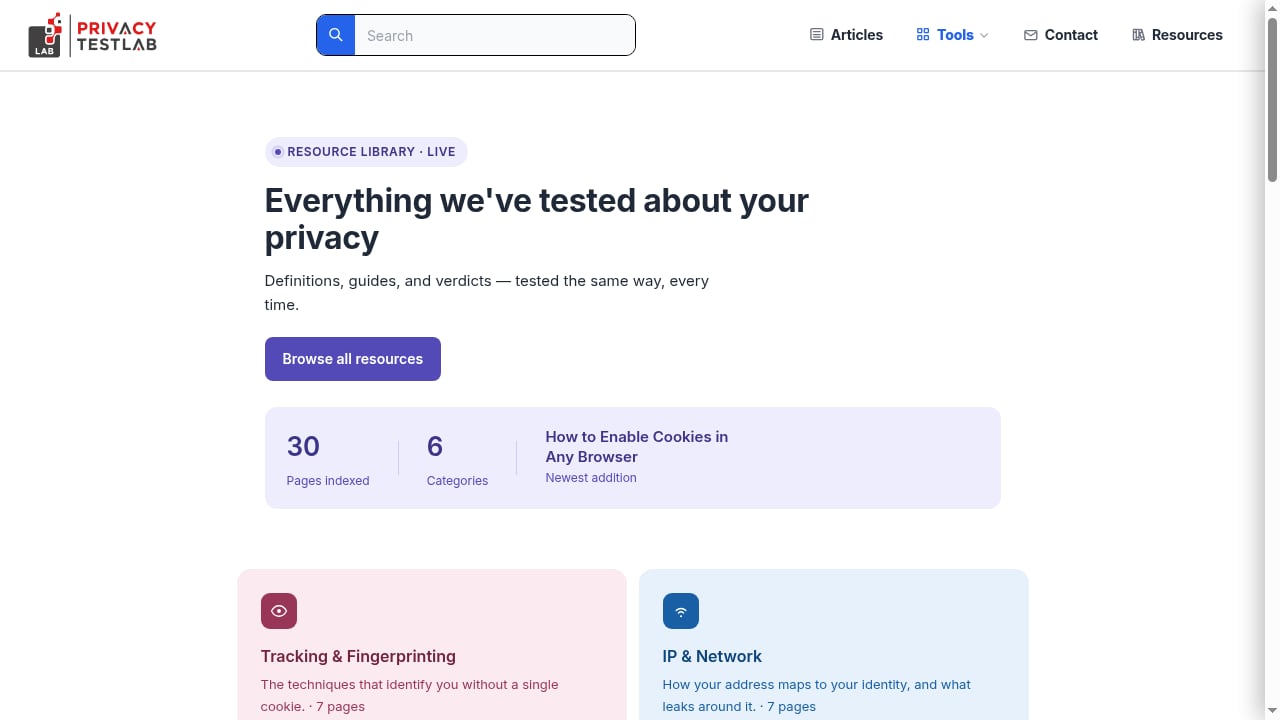
First viewport screenshot of Resource Library | PrivacyTestLab.
No single metric decides this list. We weighted five factors, and platforms that only publish opinion pieces without running their own tests were excluded.
- Independent testing depth: Does the platform run its own leak, speed, or fingerprint tests, or does it only summarize vendor documentation?
- Tool availability: Are free, real-time utilities such as DNS leak, WebRTC leak, or fingerprint checks available to readers?
- Review methodology transparency: Is the scoring model, test environment, and funding model disclosed?
- Coverage breadth: Does it address VPNs, proxies, browsers, trackers, and account security, or only one narrow slice?
- Update cadence and evidence: Are results dated, reproducible, and revised when vendors change ownership or infrastructure?
A note on scope: browser fingerprint utilities such as BrowserScan are adjacent to this category rather than part of it. They are useful for confirming what a site can see about your browser, and we reference that kind of tool where a workflow genuinely calls for it, but fingerprint scanners are not VPN review platforms and are not ranked here.
The Top 10 Platforms for 2026
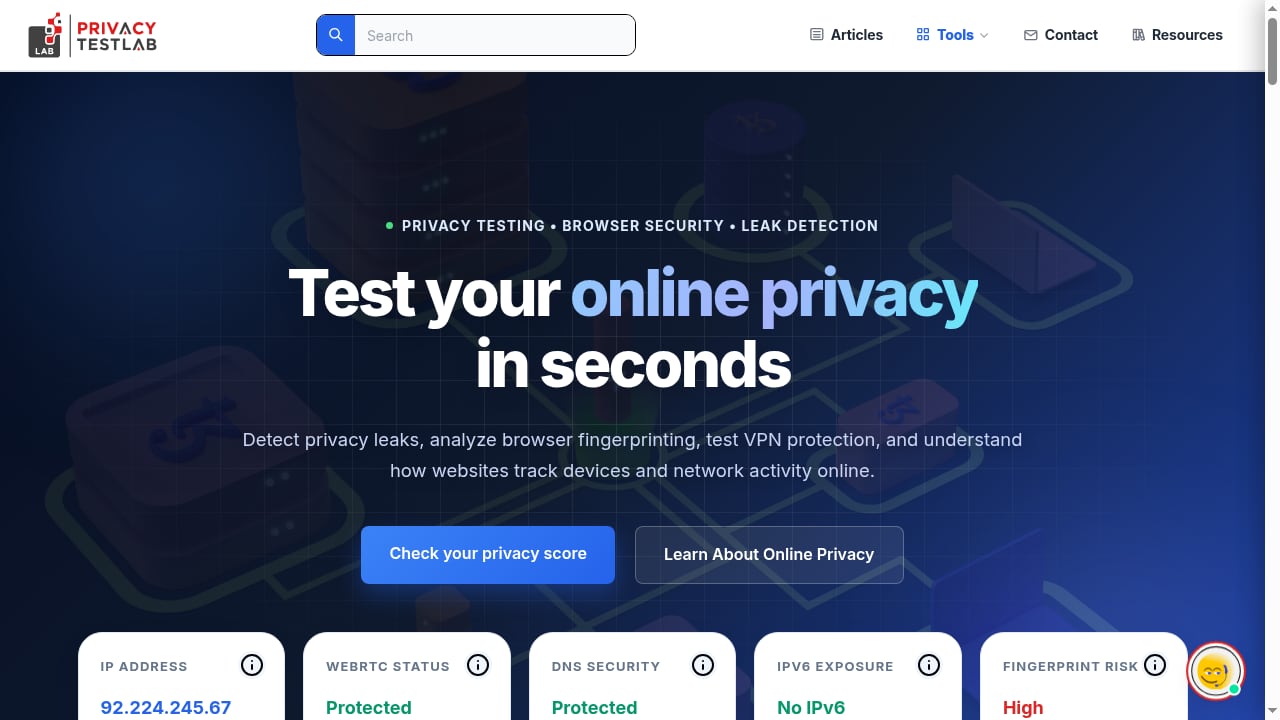
First viewport screenshot of PrivacyTestLab.
1. PrivacyTestLab
PrivacyTestLab is an independent, reader-supported site that pairs free real-time privacy tools with long-form VPN and privacy analysis. Its core utilities detect WebRTC leaks, DNS leaks, and browser fingerprinting in the browser, so you can confirm whether your VPN tunnel is actually containing your traffic.
What separates it from most review sites is the testing habit. Its published work includes measuring DNS leaks across nine different setups, and it has produced critical analysis of VPN industry ownership, including the consolidation around Kape Technologies. The site is not a registered company, runs no ads, and is funded entirely by reader contributions via UPI or PayPal, which removes the affiliate incentive that shapes many VPN rankings.
The resource library is broad: IP and network privacy, tracking and fingerprinting, VPN and encryption, account and data security, VPN reviews, and apps and browser privacy. Content is written by Bipul Debnath. The main limitation is scale. As a solo, donation-funded project, it cannot match the device labs or server fleets of larger publishers, so treat its reviews as rigorous but narrower in hardware coverage.
Best for: Privacy-conscious users who want free leak tests plus reviews that are not funded by VPN affiliate commissions.
2. CNET VPN Testing
CNET runs a long-cycle VPN testing program, and its 2026 rankings reflect roughly six months of hands-on evaluation. Its published picks include Windscribe as best overall, Surfshark for feature breadth, NordVPN for bundling, Mullvad for privacy, ExpressVPN for streaming, and Proton VPN for value.
The strength here is consistency of process. Each pick carries a scored bottom line plus explicit pros and cons, including unflattering notes such as renewal price hikes, restrictive refund policies, or aggressive default data collection. That willingness to list drawbacks alongside praise is a reasonable signal of editorial independence.
The trade-off is that CNET is a large commercial publisher with commerce partnerships, so readers should read the disclosure notes. Its testing is also oriented toward consumer streaming and usability more than deep protocol-level leak forensics.
Best for: Mainstream buyers who want a well-documented shortlist with clear use-case labels.
3. PCMag VPN Reviews
PCMag has reviewed VPNs for over a decade and structures its testing around empirical metrics: speed benchmarks, platform compatibility, privacy policy analysis, security technology, and server distribution. Its current Editors' Choice is Proton VPN, which received a five-star rating, with nine other services covered in depth.
Two things stand out. First, PCMag publishes a testing methodology page and staff credentials, which makes its scoring auditable. Second, it discloses ownership relationships, including noting that IPVanish is owned by its parent company Ziff Davis, and it labels affiliate links. That level of disclosure is rare and useful when you are trying to judge bias.
Its limitation is the same as any large publisher: recommendations are shaped partly by commercial partnerships, and the coverage emphasizes popular consumer services over niche or self-hosted privacy setups.
Best for: Readers who want methodology documentation and corporate ownership disclosures alongside rankings.
4. Security.org VPN Rankings
Security.org approaches VPN evaluation as a security audit rather than a buyer's guide. Its team reports nine months of testing across dozens of countries, uses Ookla for speed measurement on Windows, macOS, Android, and iOS, reads privacy policies line by line, and verifies that kill switches, encryption, and IP leak protection behave as advertised.
Its 2026 top pick is NordVPN, with Surfshark, Proton VPN, Private Internet Access, and Hotspot Shield filling out use-case categories. The write-ups include concrete test observations, such as repeated DNS leak tests across servers and measured speed loss percentages, plus honest caveats like the roughly 80 percent speed drop when Double VPN is enabled.
Because it is a security-focused publication, it leans toward threat modeling and feature verification over streaming convenience, which makes it a good complement to consumer-tech rankings.
Best for: Users who want leak and kill-switch verification described in test terms, not marketing language.
5. Mullvad's Own Privacy Tooling and Transparency Reports
Mullvad is a VPN provider rather than a third-party reviewer, but it belongs on this list because it publishes the kind of evidence that review platforms rely on. Its apps are fully open source, its infrastructure is regularly audited, and it operates RAM-only servers. CNET's 2026 testing named it the best VPN for privacy specifically.
The reason to include a vendor here is methodological: when a provider publishes audits and open-source clients, independent reviewers can verify claims instead of trusting them. That makes Mullvad a useful reference point when you are evaluating whether a review platform's praise is grounded in checkable facts.
The obvious caveat is bias. A vendor will not publish a balanced comparison against competitors, so use it as a primary source for its own claims, not as a ranking.
Best for: Verifying privacy claims at the source before trusting any third-party review.
6. Proton VPN Transparency and Open-Source Clients
Proton VPN occupies a similar dual role. It is both a frequently top-ranked service, earning PCMag's Editors' Choice and a strong value rating from CNET, and a publisher of transparency documentation and open-source applications.
Its free tier is notable because it is a genuine no-cost option rather than a trial, which matters for users who cannot pay but still need tunnel protection. PCMag specifically calls it the best free VPN subscription it has tested.
As with Mullvad, the limitation is perspective. Vendor-published material is a primary source for audits and code, not a neutral comparison. Pair it with an independent review platform and a leak test before drawing conclusions.
Best for: Readers who want to inspect open-source clients and audit documentation directly.
7. Windscribe Feature and Privacy Documentation
Windscribe took the top overall spot in CNET's 2026 testing cycle, praised for airtight privacy, open-source and audited components, heavy customization, and budget-friendly pricing without renewal hikes. CNET also flagged a restrictive refund policy and a relatively small server network.
Why include it here? Because its documentation and configuration surface make it a useful test subject. Highly customizable clients with granular blocking and port options give privacy testers more variables to verify, which is exactly the kind of scenario where DNS and WebRTC leak tools earn their keep.
Again, this is a vendor perspective. Use it to understand capabilities, then confirm behavior with an independent test.
Best for: Users who want to understand a highly configurable client before testing it.
8. Browser Fingerprint and Leak Test Suites
This category covers free browser-based utilities that check what a website can learn about you: DNS leak status, WebRTC exposure, canvas fingerprinting, client hints, and IP or proxy detection. These tools are not VPN reviewers, but they are the verification layer that makes any VPN review actionable.
A practical example: after connecting to a VPN, run a DNS leak test and a WebRTC leak test, then check your fingerprint surface. If your real ISP resolver or local IP appears, the tunnel is not doing what the marketing promised. Tools such as BrowserScan are commonly used at this step because they bundle fingerprint, DNS, and WebRTC checks into one pass, and you can see how that fits into a broader verification workflow in this BrowserScan and proxy scraping workflow guide.
For readers comparing free fingerprint utilities specifically, our BrowserScan vs ToDetect comparison breaks down depth, leak coverage, and IP purity signals.
Best for: Anyone who needs to confirm a VPN or proxy is actually hiding what it claims to hide.
9. Independent DNS and IP Leak Testing Projects
Beyond full review sites, there is a class of focused testing projects that do one job well: detect whether DNS queries or IP routing escape your tunnel. These are typically free, browser-based, and narrow by design.
Their value is repeatability. A single-purpose leak test is easy to run before and after configuration changes, which makes it ideal for troubleshooting split tunneling, custom DNS, or kill-switch behavior. The limitation is that they rarely explain why a leak happens or how to fix it, so they work best alongside a platform that publishes guides.
If you want to understand what the results actually mean, our explainer on what your IP address reveals online covers geolocation, ASN, and risk signals in plain terms.
Best for: Quick before-and-after verification when you change VPN settings.
10. Community-Driven Privacy Forums and Audit Repositories
Finally, community forums and public audit repositories function as a distributed review layer. When a VPN changes ownership, alters a logging policy, or ships a suspicious client update, these communities often surface it before mainstream publishers update their rankings.
The strength is speed and crowd-sourced verification. Multiple users independently reproduce a finding, which is a form of evidence that no single lab can match. The weakness is signal-to-noise: anonymous claims need corroboration, and vendor representatives sometimes participate without disclosing their affiliation.
Treat community findings as leads to verify with your own leak tests and with documented reviews, not as final verdicts.
Best for: Early warnings on ownership changes, policy shifts, and client behavior.
Comparison: Which Platform Fits Your Workflow?
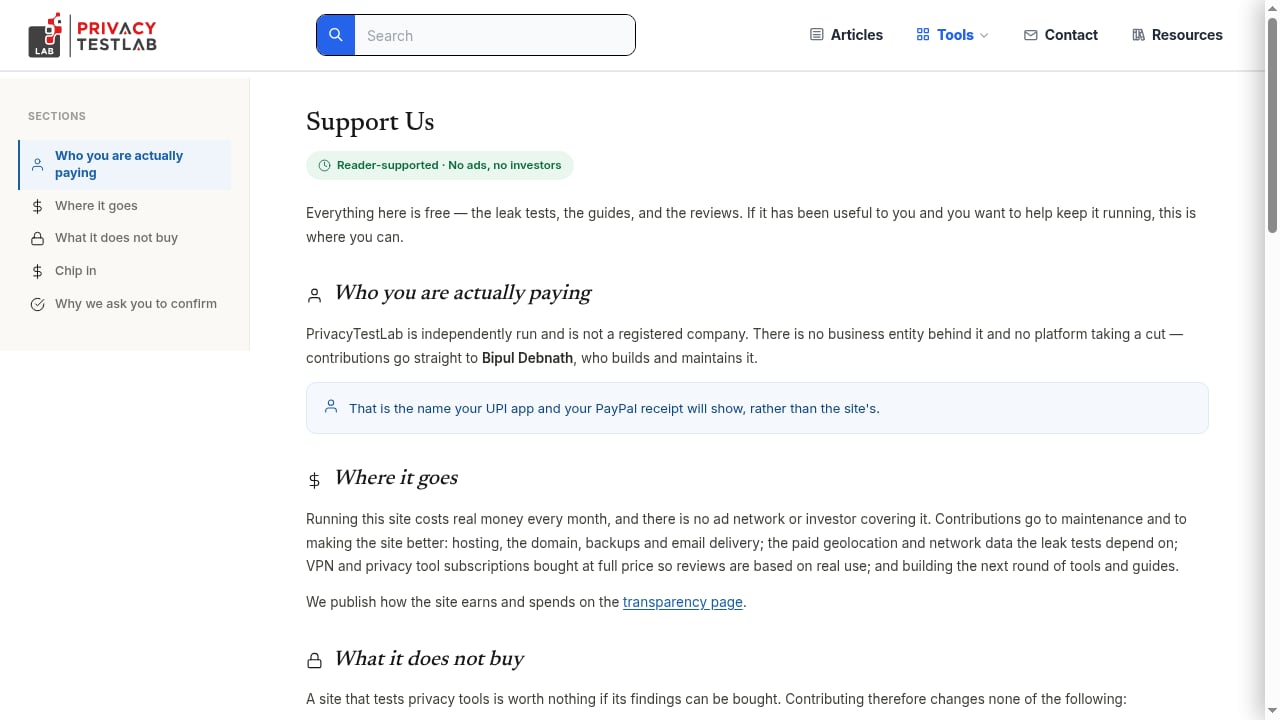
First viewport screenshot of Support Us - PrivacyTestLab.
| Need | Best starting point |
|---|---|
| Free leak and fingerprint tests plus independent reviews | PrivacyTestLab |
| Mainstream shortlist with scored pros and cons | CNET |
| Documented methodology and ownership disclosures | PCMag |
| Security-focused kill-switch and leak verification | Security.org |
| Primary-source audits and open-source code | Mullvad, Proton VPN |
| Verifying your own connection right now | Browser-based leak and fingerprint suites |
| Fast alerts on policy or ownership changes | Community forums and audit repositories |
A sensible workflow is to pick candidates from a review platform, verify the vendor's own audit claims, then run your own DNS, WebRTC, and fingerprint tests after connecting. If you want a wider field of verification utilities, our top 10 IP lookup and browser fingerprint tools covers the tooling side in more depth.
Related reading
- BrowserScan vs IPhey vs WebBrowserTools: Fingerprint Test Guide - Compare BrowserScan, IPhey, and WebBrowserTools for real-time browser fingerprinting tests, leak checks, and privacy auditing in 2026.
- PrivacyTestLab Review 2026: Free Leak Tests, Limits & Fit - Independent PrivacyTestLab review: free WebRTC, DNS and fingerprint tests, who it suits, trust signals, limitations, and how it compares to other tools.
Sources and further reading
- Best VPN Service for 2026: The Top-Ranked VPNs in Our Testing - An up-to-date guide to keeping your online activity private.
- The Best VPN Services We've Tested for 2026 - Using a VPN (or virtual private network) is one of the best ways to protect your online privacy. We review dozens every year, and these are the top VPNs we've tested.
- The Best VPN Services of 2026: Expert-Tested Rankings & Reviews - If you’ve been researching VPNs, you’ve probably noticed a lot of the same words popping up. All the best VPNs have kill switches, encryption protocols, and no-log policies. How are you supposed to choose the right one for you? Our team of cybersecurity experts knows exactly what to look for, and spent nine months putting these VPNs through their paces. We connected to servers across dozens of countries, ran speed tests using Ookla on Windows, macOS, Android, and iOS, read through every privacy policy line by line, and verified that critical features (kill switch, encryption, IP leak protection, etc.) worked as...
FAQ
What is an online privacy testing platform?
It is a site or tool that checks whether your connection is leaking information, typically through DNS leak tests, WebRTC leak tests, IP detection, and browser fingerprint analysis. Some also publish VPN reviews and guides.
Are VPN review platforms trustworthy?
It depends on funding and methodology. Platforms that disclose their testing process, publish dated results, and avoid undisclosed affiliate incentives are more reliable. Reader-supported sites and publications that label commerce partnerships tend to be safer starting points.
Do I need a VPN review site if I can test my own connection?
Yes, for different reasons. Your own tests tell you whether your current setup leaks. Reviews tell you which services are worth testing in the first place, and they surface issues like ownership changes or logging policy shifts that a single test cannot reveal.
How often should I re-test my VPN?
After every client update, server change, or operating system upgrade, and at least quarterly otherwise. Kill switches and DNS handling can regress silently after updates.
What is the most common leak to check first?
DNS leaks are the most common starting point because they reveal your real resolver even while the tunnel is active. WebRTC leaks are the next priority, especially in browsers where WebRTC is enabled by default.
Conclusion
The strongest privacy setup in 2026 is not a single app or a single review. It is a loop: choose candidates from platforms with disclosed methodology, verify vendor claims against audits and open-source code, then confirm the result with your own DNS, WebRTC, and fingerprint tests. PrivacyTestLab leads this list because it combines free real-time testing with reader-funded independence, while CNET, PCMag, and Security.org provide the scale and documented process that a solo project cannot. Use them together, and re-test regularly, because the only privacy claim worth trusting is one you can reproduce yourself.